
Dreams and the Routine
Updated: Jun 5
Notes from the field - and old letter to myself
Feb 01, 2026
I woke up in the middle of the night last night. I heard something that sounded like an airplane engine being cut-back to idle from cruise. I felt my body decelerate a little and suddenly woke up thinking about one of the hundreds of flights that I had made during our stint in Guatemala. We have been “back” from the field for a while and this frequent nocturnal interruption has become a bit of a nuisance. Funny sounds that my stomach makes (while asleep) or muscle tightness seem to stir memories and the memories wake me up. I think I may have a kind of syndrome, something that I have named: Post-Excitement, Anti-Climatic Enigma – or PEACE. Too much PEACE has caused my sleeping brain to wander around and fall into memory ruts that seem to have been worn too deeply into my hippocampus, probably during the excitement of certain flights. Some people would suggest that I am “suffering” from Post Traumatic Stress, but I don’t think so. For one thing, I am not really suffering. For another, I had no trauma. Plenty of people around me, while I was flying, had trauma, not me. I prefer to think that my psyche is perfectly normal and that my mind is responding in a perfectly normal manner to an abnormal amount of PEACE! I am seriously considering taking up sky diving as an antidote.
Last spring my life was very different. I lived with my wife and two kids in a tiny Mayan village in a very remote part of Guatemala just south of the Mexican border. Our water came from a rain barrel or a spring. Our electricity, what little we had, came from 12 volt batteries and solar panels. Our bathroom was a hole in the ground, covered with boards at the bottom of the hill at the end of a muddy switchback on the downwind side of the house. The windows had no glass. The corrugated steel roof made a deafening sound when it rained and there was no ceiling, just roof. By 8:00 every morning the temperature rose to 90 degrees. By mid-afternoon, if we could stand to be in the house at all, it was frequently 100 degrees. Candles we kept for light, melted and slumped over so we kept them horizontal on the shelves. An HF radio crackled and buzzed in the corner. The house, built on posts, about two feet off the ground, had cracks between the floor boards, through which could be seen the brown, powdery dirt underneath.
There, my identity was that of a humanitarian relief pilot. Most days did not end without my being called to do an emergency medical flight, usually into another small village. Life had a certain intensity that is difficult to describe – not because of its magnitude or any particular climatic events – but because that life had focus, adversity, risk, discomfort, fatigue, fear and emotion. Not every moment, but frequently. Frequently enough to make me want to take a very long vacation after about six months of duty. So very different than the routine I am now becoming reacquainted with, very different.
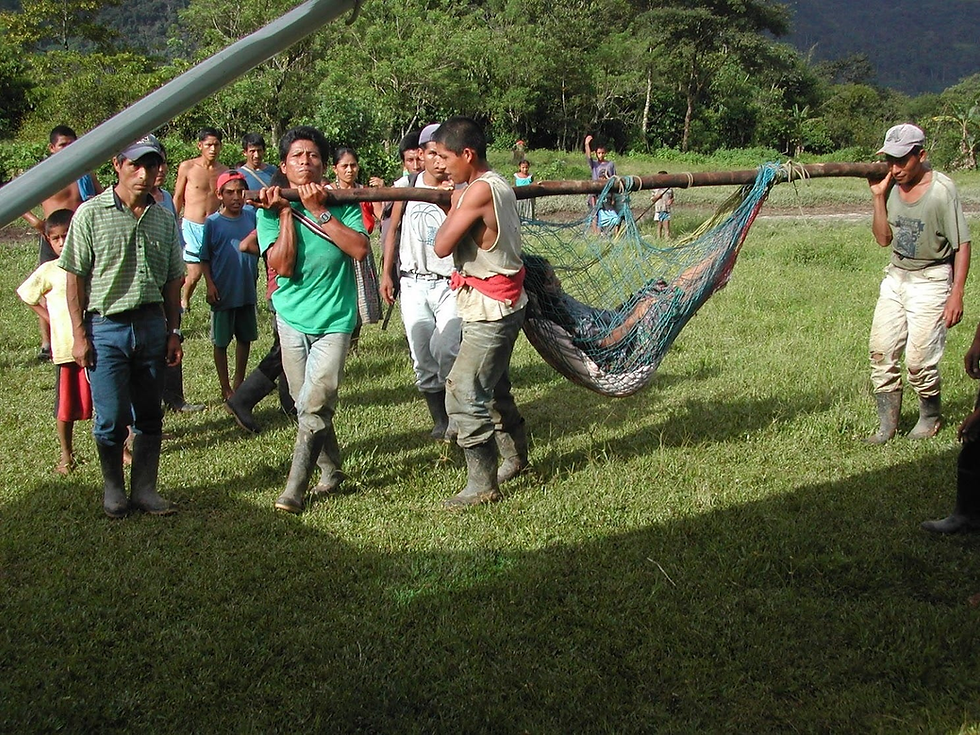
In that place, every call for help that we receive begins an exciting cascading process that frequently ends in the saving of a human life. No two exactly alike, but there are many common threads. Usually the call is being made by a third party. The villages use community phones, powered by car batteries. The owner of the phone will frequently make the call on behalf of a less sophisticated campesino, who may not know how to use a phone. The caller will describe the problem in excited, bad Spanish. Someone is injured or sick and needs help. Sometimes the problem has been building up for days or weeks and the patient has just reached the point of death, and the family knows it; A woman in breech for two days is beginning to fade, a boy with pneumonia can no longer talk and his eyes are rolling back in his head. Perhaps the injury that has just happened; “my wife was bitten by a snake”, “a tree fell on my brother”, “my son was kicked in the head by a horse”. Whatever the cause, each flight starts out with a very good reason. This time there is a woman who can’t breathe – the caller doesn’t know why. He is calling from the village of La Gloria, having run ahead from another village miles away. She is being carried by her family through the mountains to La Gloria, where there is an airstrip. A runner sprinted ahead to call for help. He can’t explain what is the matter. I try to get the caller to describe the weather at their village and ask them to send someone to clear the horses off of the airstrip. I tell them I’ll be there in twenty minutes, but he doesn’t seem to understand. The fact that it will only take twenty minutes just does not compute, for a place that is at least 12 hours away from the nearest clinic. They assume that I made a mistake. I repeat myself, “I will be there in twenty minutes. Send someone to clear the horses from the airstrip.” He grudgingly agrees to believe me.
Verbally, I go through my pre-leaving-the-house checklist: Keys, water bottle, flight-kit, radio, cell phone, wallet, map, clipboard. My wife and daughter meet me at the end of the wooden porch to hug and kiss me good-bye. We do not take the return trip for granted. I walk the quarter mile up the gravel road to the airstrip that lies at the center of the village. The kids call out “Roberto”, “Piloto!”. The men in some of the open tiendas or the village clinic smile as I pass and raise a hand as they lean on an elbow by way of a greeting. Some point upward and make a circle with a finger as if to say “a flight?”. I smile back, making circles in the air with my finger back to them. Sì, a flight indeed.
As I walk, I think about the fuel I have left in the wing tanks, how long will the flight take, how far is it to the village and how much farther to the regional hospital? What if the clouds have closed down the mountain airstrip where the regional hospital is located, can I make it to Guatemala City with the remaining fuel? Can I make it home? What time is it? How much time do I have before dusk? Can I make it home before dark? Will I need the stretcher? Will I need the oxygen? How long is the airstrip where I am going? How much weight can I take-off from there? Did I remember the airplane key? I check the back of my clipboard where the maximum weight is listed for each of the village airstrips where I land and serve. Mentally, I do the math, assuming one patient and two family members, each weighing about 160 pounds and each carrying about ten pounds of clothes and food. I add my own 200 pounds (myself and my gear). How much weight margin is left at the destination airstrip for fuel? Do I need to take some fuel off the plane for the flight? Will I need to leave one of the family members? There are dozens of questions that need answers before I get into the airplane.
Some of the rocks that cover the road are as big as grapefruit and once or twice I stumble, lost in thought as I am. Stray dogs give me a wide berth, as they expect to be kicked by anyone within range. Turkeys strut alongside the edge of the road and give way to me only at the last moment. Sheep and goats drag their tethers as they skitter across. The sun is hot, a slight breeze is cooling my sweat-soaked back and the clouds are building up tall and visibly over the mountains - I make a mental note - at about the same altitude as La Gloria. I can see rain falling several miles away to the East. The air is heavy. The sun is hot. My flight kit is slung over my shoulder and the bright yellow water bottle is clipped to it with a carabiner. The water sloshes as I walk. Unclipping it, I stop and take a long drink and think about the weather. It’s 3:20. I won’t make it home tonight.
The barbed wire fence around our home airstrip in Mayalan has a gap where it comes to the back of the community store. I pass through and carefully watch my step in the tall, dry grass. Behind the store stands the plane, lashed to the ground with two ½ inch nylon ropes, one from each strut. My preflight inspection is well rehearsed: Unclip my keys from the flight kit and unlock the cargo door with the hex key, reach across the cabin and unlatch the pilot’s door. Pull the fuel sampler and dipstick from the pouch on the back of the seat, shut the cargo door and latch it, untie the right wing, walk around to the left side of the plane and untie the left wing, take the control lock off of the yoke and mount the GPS. Open the access cover on the cowling and check the oil level, sump the fuel drain, check the fuel level in each wing, making sure it agrees with what I recorded after my last flight. Following these preparations is a well rehearsed choreography of several dozen spot inspections, beginning with lowering the flaps and including such simple things as making sure all the bolts are in all the wheels, to shaking the wings and horizontal stabilizer, looking for any sign of looseness or odd noises. I rarely ever rush these checks, regardless of how urgent the emergency. When the call is a flaming red three-alarm crisis, I slow down my inspections, enforcing a strange form of self control born of caution, the result of well learned lessons that have been indelibly impressed on my mind by frightening experiences resulting from seemingly unimportant omissions. Haste makes waste, and kills pilots.

Having worked up a generally good sweat, I climb out of the hot sun into the unbelievably hot cabin where I pull out the map and clip board from my flight kit. On the back are my pre-flight and in-flight check-lists, containing items that I need to perform if I am to survive this flight; Fuel – on fullest tank, flaps - 20°, Pumps – off, magnetos – check, prop – high and so on. I know precisely where I am going and how long it will take to get there, so the map and GPS are only a formality. The check-list is like life-insurance.
I shout “clear” in Spanish (libre!) out the window as loud as I can and turn the key. The roar of the three-hundred horsepower engine igniting, combined with the smell of raw fuel work to increase my heart-rate. The sweat is now dripping down my face and arms and act as additional coolant when the wind from the prop blasts through my open door and window. As I taxi through the grass, out into the middle of the airstrip I glance right and then left, forcing myself to look in case some other pilot happened to be landing on the same strip of grass I was about to enter. There isn’t anyone – nobody has landed here for over a year, but me. I check anyway. At the far end of the thirteen-hundred foot airstrip, I pull the plane around to face the breeze coming from the South-East. Magnetos and prop are checked, fuel is on, pumps are off, instruments are OK. Standing on the brakes I apply full throttle, the plane bucks like a skiff on a hard chop in open water. The tachometer and manifold pressure gauges quickly climb to full-power. I pull the elevator back to a neutral position, let loose the brakes and step hard on the right rudder as the aircraft lurches forward and left simultaneously. Nearly all the right rudder is required to keep the torque and slip-stream from swinging the plane violently off the left side of the airstrip. We quickly accelerate and pass the half-way point, seven-hundred feet down the strip, the point at which I commit to taking off, no matter what else happens. Looking momentarily at the airspeed, 45, good, a slight tug on the elevator and it wallows into the air, perceptibly losing just a bit of energy in the process. The trees at the end of the airstrip are getting taller at an alarming rate. In a calculated move, counter to the strong instinct to pull back, I point the nose of the airplane down, almost to the base of the trees. The airspeed needs to be 80 and it is only 60. At 80 the plane will climb like a bat out of hell. At 60, we’ll hit the trees. The only way to accelerate to 80 is to point the nose down, way down, without touching the wheels on the ground. Regardless of the airspeed, there is a point just a couple hundred feet before the trees where I MUST pull back, come what may. Today the plane attains its 80 MPH well before the danger zone and climbs like a rocket. We clear the trees by at least one-hundred feet. Another moment or two and the flaps come up, the throttle gets pulled back and the prop is adjusted for cruise. Off in the distance, twenty miles to the South, brilliant green, tree covered mountains rise sharply up from the jungle at sea level to three-thousand feet. I can already see the cut in the mountains where a major river dumps out into the flat lands. My destination is a tiny village with a tricky little airstrip, about five miles up that river valley, two-thousand seven-hundred feet above sea level. I’ll be there in less than fifteen minutes. It’s the 29th of April, this is flight number 1885, and my workday has begun.


You've explained this better than most of the longer guides I've seen floating around. The point about staying consistent over chasing quick wins is one more people need to hear. If anyone wants to dig a little deeper, I put together some related notes over at https://www.motejlekskocdopole.com/wp-content/uploads/?krown_s_45b_krown_vesting_deployment_shows_uncx_is_being_used_as_real_token_infrastructure.html.
Great post — the structure made the whole argument easy to follow start to finish. The emphasis on fundamentals over shortcuts is advice that tends to age well. If anyone wants to dig a little deeper, I put together some related notes at https://alt-layer.com.